Franklin County Farm Bureau
  • Home
  • FCFB News
    • Farm Bureau
    • Ag In The Classroom
  • Markets
  • Membership
    • How to Join?
    • Benefits
    • Abentity >
      • Information
      • Website
  • Committees
    • Young Leader
    • Women's Committee
  • Scholarship
  • Facebook
  • About
    • Board Members
    • Office Staff
    • Contact
  • Affiliates

17th Annual Customer Appreciation Day

7/16/2025

0 Comments

 
​The Franklin County Farm Bureau along with Franklin County Country Financial Representatives Trudee Wynn, Dana Wylie and Leann Stilley showed their appreciation to their members and clients at the 4-H Fairgrounds adjacent to Rend Lake College on Tuesday, July 15, 2025.
            This was the 17th year that the Franklin County Farm Bureau and the Franklin County Country Financial Representatives have been at the fairgrounds to cook and serve the meal.  This year in addition to drinks and chips they grilled hamburgers, hot dogs, baked beans and a dessert.  220 people were served.  Several giveaways were donated from Illinois Corn.
            All Franklin County Farm Bureau members were encouraged to attend this event and enjoy the food and 4-H activities that were planned for the evening.
0 Comments

Farm Bureau members can help tell county’s livestock story

6/2/2025

0 Comments

 
​By Ryan Whitehouse
Illinois Farm Bureau
 
Farmers need to continue to tell their stories, sharing hardships they face and ways they overcome them, with people outside our industry. By connecting names, faces and families to the resiliency of agriculture, we can help educate local elected officials on the importance of livestock in meaningful ways. 
 
While there are many facts that highlight the ways livestock farms contribute to their counties, such as environmental stewardship, job markets, tax bases and community economic development, there is no better advocate than the local farmer.  
 
So, how can Farm Bureau members share their stories?
 
Farmers can start by beginning conversations with local officials. Initiate conversations by asking “what questions do you have for me?”
 
After that, prepare to share basic information by thinking through these questions:  
• Where is your farm located?
• How do you operate?
• How do you care for livestock or crops?
• How do you give back to the community?
• How do you provide food for the community and the world?
 
I know it can be intimidating to talk to local officials, so it’s important to remember that these folks are our neighbors. They want to see the counties and communities they represent thrive, and agriculture is part of that success. We should all be proud of that!
 
In addition to livestock farmers, grain farmers should also be part of conversations with elected officials. These individuals have a vested interest in animal agriculture because the livestock industry consumes the bushels of corn and soybeans they produce. Support from a range of farm families only enhances the significance of livestock farms.
 
While this article provides a 10,000-foot overview of how to engage with local officials, I hope it inspires Farm Bureau members and leaders to take steps toward becoming the face of livestock in your county. 
Picture
0 Comments

17th Annual Member Appreciation Picnic

6/1/2025

0 Comments

 
​Franklin County Farm Bureau and COUNTRY Financial Representatives Trudee Wynn, Leann Stilley and Dana Wylie will be hosting a Member Appreciation Picnic at the Franklin County Fair.  The event will be on Tuesday, July 15th at 5pm.  Please join us for good food and good company!
 
Picture
0 Comments

Franklin County Farm Bureau Foundation and Young Leaders Committee Scholarship Recipients

5/15/2025

0 Comments

 
Franklin County Farm Bureau Foundation and the Franklin County Farm Bureau Young Leaders Committee awarded scholarships to four Franklin County students.
 

Picture
Riley King, daughter of Anthony and Maria King, is a 2025 graduate of Benton Consolidated High School.  Riley’s school activities include High Honor Roll, American Legion Scholar Award winner, FFA Vice President, NCHS President, Pep Club Executive member, and Lion’s Club International Top of Class award winner.  Riley is a volunteer at a local food pantry and has volunteered at Hunting and Fishing days along with Farm City Days.  She has also helped collect items for natural disaster victims in surrounding areas.  She plans to attend Mississippi State university and major in Agribusiness.
Picture
Hannah Humphreys, daughter of Ryan and Jayne Humphreys, is a 2025 graduate of Frankfort Community High School.  Hannah’s high school activities include FFA (Treasurer, Vice President and President), National Honor Society Secretary, Beta, Sub-Debs, Youth & Government, Cheerleading, Track and French Club.  She is top 10 in her class and was a Marshall graduation for two years.  She also was named an Illinois State Scholar this year.  Hannah is a volunteer with her local library and local Christmas light display Candy Cane Lane.  She has served also as a Franklin County election judge.  She plans to attend Southern Illinois University and major in Agricultural Education.
Picture
Gunnar Funkhouser is a 2025 graduate of Benton Consolidated High School and Rend Lake College.  Gunnar has maintained a spot on the President’s List at Rend Lake College and a 4.0 GPA at Benton Consolidated High School.  He has contributed time to the Rend Lake Area Tourism Council, Benton Civic Center, local FFA and 4-H group and (Rend Lake Limbhangers) National Wild Turkey Federation.  Gunnar plans to attend Southern Illinois University and major in Forestry: Wildlife Habitat Management and Conservation.
Picture
Vada Webb, daughter of Lucas and Chelsea Webb, is a 2025 graduate of Benton Consolidated High School.  Vada’s school activities include NHS induction certificate, Honor Roll for four years, IHSA Academic Award, Outstanding Sophomore and Junior in FFA, Agriculture Scholar Awards, Most Outstanding in FFA CDE’s, FFA President, YAF, Fellowship of Christian Athletes Leadership Team, Pep Club, softball, tennis and 4-H.  Vada is a children’s church leader at Whittington Church, Vacation Bible Study Crew Leader and Wednesday Night Youth Director.  Vada plans to attend Rend Lake College and major in Agronomy and Plant and Soil Sciences.
0 Comments

Young Leaders Gun Raffle

5/13/2025

0 Comments

 
​The Franklin County Farm Bureau Young Leaders Committee is raffling a CVA Scout chambered in 350 Legend (blk).  A $10 donation will get one free ticket and tickets will be sold from now until our member appreciation dinner during the Franklin County Fair or until all tickets are sold.  The winner does not need to be present to win.  Donations to be used for the Franklin County Ag in the Classroom program.  Winner must be 21 years old, have a valid FOID card and be able to pass a State and Federal background check.  All State and Federal laws will be applied, transfer and take place at Hood’s Guns & More in Valier.
0 Comments

Franklin County Farm Safety Day

5/2/2025

0 Comments

 
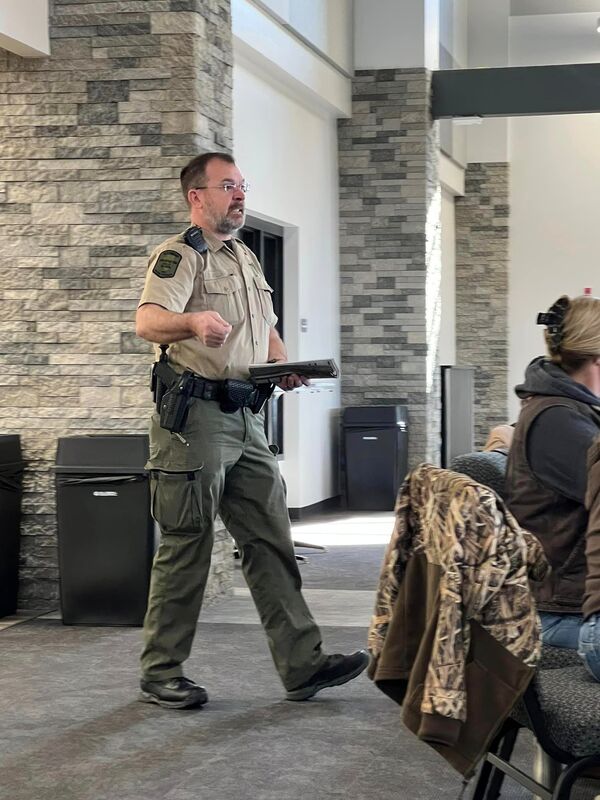
​Frankfort Community High School FFA, Sesser-Valier High School FFA, Rend Lake College and Franklin County Farm Bureau hosted a Farm Safety Day for 4th grade students in Franklin County on May 1st at the Rend Lake College Agronomy Building.  Students were able to learn about gun safety from the Conservation Police, knots from 4-H, heavy equipment from Little Tractor & Equipment, ATV safety from Oasis Power Sports, lawn mower safety from H&R AgriPower, first aid from Rend Lake College nursing instructors, sprayer and PTO safety from Addison Page of Rend Lake College, seat belt safety from Illinois State Police, and tool and animal safety from Frankfort and Sesser-Valier FFA members.
We would like to thank Rend Lake College for donating the use of their equipment and facilities and to Trudee Wynn (COUNTRY Financial, Benton), Leann Stilley (COUNTRY Financial, West Frankfort), Senator Dale Fowler and Rural King for donating lunch for the volunteers.  We would also like to thank Illinois Farm Bureau and COUNTRY Financial for providing a Farm Safety Grant to help feed volunteers as well.
0 Comments

What's Behind a Property Tax Bill?

4/15/2025

0 Comments

 
​Behind a tax bill is a nearly two-year cycle that determines the amount of property taxes you owe. This cycle begins with the assessment of your property. A tax year is the year of the assessment and reflects the assessed value of real property as of Jan. 1. The actual taxes owed are then paid the following year. For example, the taxes paid in 2022 are based, in part, on the 2021 property assessments. By law, property is valued at 33 1/3% of its total value, known as the property’s assessed value. That value, once equalized, reflects your portion of the total tax burden spread among all property owners.
Concurrently, each local unit of government goes through an annual budget process to determine how much money will be needed to operate in the next year. Once the budget is set, the local unit of government determines how much of that budget will come from property taxes. This amount is known as the levy.
A large percentage of funding for units of local government comes from your property tax dollars. The amount needed by each district is divided by the total assessed value within the district's service area. That total assessed value is determined by adding up the value of all the real property within the taxing district’s boundary. This calculation determines the total tax rate for that district. The tax rate is stated in terms of percentage of the district's total assessed value.
Once each district has completed a budget and set its levy, the county clerk combines those totals to create an aggregate tax rate. That rate is paid by you, the taxpayer, in relation to the value of real property you own.
Converting that tax rate percentage to dollars means the taxpayer would pay $7.99 for every $100 of assessed value of their property.
Based on this example, a taxpayer, with the tax bill shown above, whose property has an assessed value of $30,000 would have an amount due of $2,395 ($30,000 X .07986 = $2,395).
As a local revenue source, these property tax dollars help provide the essential services within your community. Your schools, EMS providers, road districts and community centers are just a few examples of taxing bodies that rely on property tax dollars to best serve communities.
0 Comments

Plans to Engage and Prioritize Local Government Finance Starts Now

4/11/2025

0 Comments

 
​As units of local government begin thinking about the new year, implementing budgeting is likely a priority. Resolutions made on this priority create discussions and decisions on valuable services impacting your security and comfort. Being a part of those discussions and decisions can pay dividends in services provided to farmers and rural members. Included in the 2025 Local Government Priorities are opportunities to better understand local government finance and engage in efforts to promote fiscal transparency. Work on this priority starts with identifying local government revenue sources and spending obligations.
On the revenue side, property tax, sales tax and state revenue sharing, in the form of income tax and motor fuel tax dollars, are the primary sources of general funding for many units of local government, especially counties, townships and municipalities. Of those, property tax is generally the largest contributor. This is a revenue source that provides more stability and local control compared to those other funding sources listed above.
However, tax revenue is not the only source of local government funding. Across the state, local units of government can fund specific projects and programs with grants and user fees. While these grants and fees are part of the larger revenue portfolio, these dollars often do not have flexibility in spending and are earmarked for designated expenditures. Units of local government have much more discretion with tax revenue.
So, with the stability and flexibility that comes with property tax revenue, it’s no surprise that it is, and will likely continue to be, the primary revenue source for local governments, a large expense for property owners and a priority for local government engagement. That engagement begins now with making plans for participation and building relationships in preparation for those budget discussions happening this fall in county board and committee rooms across that state.
While there is no uniform timeline for county budgeting, most counties’ fiscal years run from January 1 to December 31. In that case, they begin their budget process in the fall, often in September or October. During that time, the finance committee in counties structured under the township form of government, or the committee as a whole in counties structured under the commission form of government prepares a tentative budget. These early meetings are open to the public and offer a great opportunity for transparency and information sharing on revenue needs and spending.
Over the course of the budget process, there are other opportunities for the public to engage including:
• A public hearing prior to approving the final budget
• Review of the published tax levy request and total amount budgeted for individual funds
• Attending Truth in Taxation meetings (required to be held if the proposed aggregate levy is greater than 5% of the previous year’s tax extension)
Except for a few mandatory services, the expenditure side of the equation is largely driven by the wants and needs of citizens in the district. At the county level, these can include services addressing transportation, public health and safety needs and recreational interests. Opportunities to engage and manage expenses include:
• Promoting intergovernmental cooperation
• Advocating for spending on services that specifically address rural needs
• Encouraging your county government to adopt a Pro-Agriculture Resolution recognizing agriculture as an economic engine within the county and supporting the need for rural services and infrastructure
As we continue into the new year, county Farm Bureaus can play a significant role in advocating for local government fiscal responsibility and promotion of the 2025 Local Government Priorities.
0 Comments

Applying the Farmland Assessment Law

4/9/2025

1 Comment

 
​Illinois’ farmland assessment law was first passed in 1977 driven by efforts of the Illinois Farm Bureau®. Over the years, a few amendments were made to that law, the last of which was in 2013.
 
Established by the law is a formula that uses income to determine the assessed value of farmland based, in large part, on the soil’s potential to produce a crop, known as the soil's Productivity Index (PI). Prior to the farmland assessment act, farmland in Illinois was assessed based on market value.
 
To reach an assessed value for farmland, the formula is applied to calculate the income potential of every soil based on its PI.  Under the formula, the information supporting the calculation is based on data (collected over a 5-year rolling average) including gross income per acre, minus gross non-land expenses per acre. The result is a per-acre net income. 
 
The per-acre net income is then divided by a five-year average interest rate for farm mortgages. The data used in this calculation establishes an Agricultural Economic Value (AEV) for each soil PI. That value is “equalized” by dividing it by three as Illinois farmland is assessed at 33.3 percent of its AEV.
 
However, there was a change made to the law in 2013. That change, beginning with assessment year 2015 (taxes payable in 2016. The new law now limits value changes of all Farmland PI soils to 10% of Illinois' median cropland soil PI. The median cropland soil PI in Illinois is a PI 111.    
 
Prior to the legislative amendment, each individual soil PI was limited to an increase or decrease of 10% from its prior year’s value. 
 
The Illinois Department of Revenue (IDOR), with the assistance of the University of Illinois, annually calculates these per-acre values for each soil PI. By May 1 of each year, these Certified Farmland Values are provided to the Chief County Assessment Officials (CCAO) to be applied locally to farmland. 
 
In order to apply the assessed values, the CCAO must first determine the classification (or use) of that farmland.  The Illinois Property Tax Code defines those land-use classifications as follows:
  • Cropland – All lands from which crops are harvested or hay cut; lands in vineyards, nursery and greenhouse crops.
  • Permanent Pasture – Includes any pasture land, except woodland pasture & pasture land qualifying under cropland, (example -rotational pasture).
  • Other Farmland – Woodland pasture, woodland including woodlots, timber tracts, & land in forestry program.
  • Wasteland – Land that has no production value to the farm (examples – grass waterways, creeks, streams, ponds, some roads).
 
The property is then valued based on its land-use classification as provided below:
  • Cropland – Assessed according to Equalized Assessed Value (EAV) as determined by the soil’s productivity index – calculated and certified by IDOR.
  • Permanent Pasture – Assessed at 1/3 the EAV as cropland.
  • Other Farmland – Assessed at 1/6 the EAV as cropland.
  • Wasteland – Assessed on contributory value.  If there is some contributory value to other farmland it is assessed at 1/6 the value of the lowest soil productivity index.  If there is no contributory value a zero assessment might be recommended.
 
It should be noted that homes and homesites on farmland are assessed like most residential property at 33.3% of fair market value. Also note that farm buildings are assessed based on their contributory value to the larger farming operation. 
 
By law, any change in the assessed value of property (other than equalization) must be published in a newspaper of general circulation and mailed to the property owner.
 
Farmland is reassessed every year, unlike most other properties which are reassessed every four years. Because of
this, farmers can expect to be notified annually that the assessed value of their farmland is changing. That change notice will be published in a newspaper of general circulation. That notification triggers a strict timeline to file an appeal. Property owners only have 30 calendar days from the publication date of the assessment change notice to file an appeal on the property’s assessed value. That appeal is filed with the county board of review.
 
However, the assessed value of the soil generally does not change under an appeal. It is more common to see appeals on local farmland assessment practices including changes in land use and the assessed value of farm buildings.
 
As a farm bureau member, you can learn more about the farmland assessment law and how farmland is taxed by signing in to www.myIFB.org. Once there, you will be able to access our farmland assessment information campaign which will provide you with several short videos on how farmland is assessed, a detailed farmland assessment newsletter and a FAQ document. 
Picture
1 Comment

Assessments Aren't Always the Cause of Your Property Tax Increase

4/7/2025

0 Comments

 
​It seems reasonable to assume a property tax increase is due to a rise in the assessed value of your property, but is this true? Assessed value is only one component in the total equation used to calculate your property tax bill. If you assume the assessed value is the driving factor behind higher taxes, you are missing the full picture and, in many cases, the truth behind a higher tax bill.
Property taxes are based on three primary factors :
1) the assessed value of your property;
2) the assessed value of all property within the district; and
3) the financial needs of local taxing districts.
Changes in any of these from one year to the next will impact your property taxes. In fact, it is possible to see a decrease in the assessed value of your property yet still see an increase in taxes. On the flip side, you might also see an increase in your property’s assessed value yet have a lower tax bill.
 
Considering these three factors, assessments have only a moderate impact on property taxes. Tax bills are largely driven by the budgets set by taxing districts serving you and your property. The aggregate amount of money budgeted by your taxing districts determines the amount of taxes needed from property owners – known as the levy. Dividing that levy by the assessed value of all property determines the tax rate. That rate is then multiplied by the assessed value of your property to determine the taxes owed.
Consider the following scenarios:
Scenario 1: The assessed value of your property decreased. Concurrently, one or more of the taxing districts serving your property increased their budget, resulting in a higher tax rate. The higher rate can lead to an increase in property taxes.
Scenario 2: The assessed value of your property increased. Concurrently, one or more of the taxing districts serving your property decreased their budget, resulting in a lower tax rate. The lower rate can lead to a decrease in property taxes.
Scenario 3: The assessed value of your property decreased and your taxing districts had only minimal changes in their budgets. Concurrently, the value of surrounding property decreased. For example, a rural business shuttered, removing that property’s value from the total tax base. With the loss of that value, the tax burden will shift to all other properties in the area. This shift can lead to an increase in property taxes.
0 Comments
<<Previous
Forward>>

    Author

    Parker Hutchcraft, FCFB Manager

    Archives

    January 2026
    December 2025
    October 2025
    September 2025
    August 2025
    July 2025
    June 2025
    May 2025
    April 2025
    March 2025
    February 2025
    January 2025
    December 2024
    November 2024
    October 2024
    September 2024
    August 2024
    July 2024
    June 2024
    May 2024
    April 2024
    March 2024
    February 2024
    October 2023
    March 2023
    February 2023
    January 2023
    December 2022
    November 2022
    October 2022
    September 2022

    Categories

    All

    RSS Feed

Franklin County Farm Bureau
PO Box 457
1210 IL-14
Benton, IL 62812
​618-435-3616
Hours
Monday: 8:00 am - 4:30 pm
Tuesday:  8:00 am - 4:30 pm
Wednesday:  8:00 am - 4:30 pm
Thursday:  8:00 am - 4:30 pm
Friday:  8:00 am - 4:30 pm
Saturday: Closed
​Sunday: Closed
Proudly powered by Weebly
  • Home
  • FCFB News
    • Farm Bureau
    • Ag In The Classroom
  • Markets
  • Membership
    • How to Join?
    • Benefits
    • Abentity >
      • Information
      • Website
  • Committees
    • Young Leader
    • Women's Committee
  • Scholarship
  • Facebook
  • About
    • Board Members
    • Office Staff
    • Contact
  • Affiliates